2021.07.02
Micron Stock's Flawless Q3 F’21 Results Misinterpreted By Market (NASDAQ:MU) | Seeking Alpha
Micron's Flawless Q3 Fiscal 2021 Results Misinterpreted By Market
시장이 오해하는 마이크론의 완벽한 3분기 실적.
요약:실적 발표 내용에 시장의 예상보다 많은 설비 투자 금액이 있었다
시장은 투자 금액 증가가 공급 과잉을 일으킬 것으로 생각하나, EUV 장비 투자는 일반 장비보다
투자 금액이 많이 들며, 생산의 어려움으로 공급을 증가시키지 않는다는 설명.
Summary
- Micron delivered a flawless quarter for its Q3 F'21 earnings last night after the market close. Alas, the market has misconstrued the results, leading to a negative reaction.
- 어제 마이크론은 장 마감후 완벽한 3분기 실적을 발표했다. 하지만 유감스럽게도 시장은 이 실적 발표를
- 잘못 이해하면서 부정적인 반응을 보였다.(분석: 실적 발표 내용에 시장의 예상보다 많은 설비 투자 금액이 있었다.시장은 이를 공급 증가로 우려해 2018년과같은 메모리 가격 폭락을 우려함)
- Analysts were understandably concerned by a fear of rising capital expenditure that may presage a supply glut, a perennial feature in the feast-to-famine cycles of yesteryear.
- 애널리스트들이 증가한 설비 투자 금액이 공급 과잉을 일으키고 지난해처럼 호황과 불황이 반복되는 것의 전조가 될것으로 우려하는 것은 이해할 만하다.
- The article highlights why this fear is understandable but entirely misplaced.
- 이 글의 요점은 이런 공포가 이해할 만하지만, 완전히 잘못됐다는 것이다.
- Another possible negative is the market's interpretation of supply chains moving from 'just in time' to 'just in case' due to COVID disruptions, thus leading to another layer of inventory and opacity in demand.
- 시장의 또다른 오해는 공급망에서 변화가 생긴 것을 오해한 것이다. 이전에는 공급이 '적시 공급'이었으나
- 이제는 코로나 사태로 언제 공급이 중단될지 모르므로 '만약에 대비한 공급'으로 변화되면서,
- 재고를 이전보다 더 축적하고 수요 예측이 불확실하게 되었다.
- However, this is simply a reconfiguration of supply chains in light of COVID volatility; it can hardly be interpreted as a negative for Micron. Strong Buy on Mr. Market's misapprehensions.
Micron (MU) released their Q3 F'21 quarter results last night after market close that were received with skepticism by the market. In my opinion, the results were outstanding in virtually every aspect. Alas, given fears expressed by Wall Street analysts (see below) during the conference call, Micron closed down by 2.2% on 5.7 million shares in the after-hours market.
마이크론이 장 마감후 3분기 실적을 발표하였는데 시장은 이를 비관적으로 인식했다.
내가 생각하기에 실적은 모든 면에서 뛰어났다.
하지만 유감스럽게도 실적 발표 컨콜중에 마이크론 주가는 시간외 거래에서 2.2% 하락하였다.
This article is a short but necessary rebuttal of Wall Street's interpretation of yesterday's results. For a more detailed exposition of why Micron demands a rerating in the shedding of its cyclical stripes to a secular growth story in the transformed landscape of digital memory, I refer readers to my article, Micron's Transformation Demands A Valuation Rerating dated April 8 '21.
Micron beats consensus for the quarter on revenue and earnings
First, the detail on the May quarter results disclosed.
- Revenue of $7.42 billion versus $6.24 billion for the prior quarter and $5.44 billion for the same period last year
- Operating margin for the quarter jumped to 31.9% from the previous February quarter of 20.2% and the prior fiscal year of 18.0%. This demonstrated the outstanding operating leverage inherent in the business
- Non-GAAP net income of $2.17 billion or $1.88 per diluted share
There is no ambiguity in the clear surprise to market consensus that stood at revenue of $7.23 BN and non-GAAP EPS of $1.71. The surprise of 10% on earnings for the quarter is a reflection of the operating leverage inherent in rising average selling prices (ASPs) of both DRAM and NAND. As CEO Mehrotra explained in the call (my italics).
다음은 마이크론 사장 메로트라가 컨콜에서 언급한 내용이다.
Revenue growth was driven by stronger DRAM and NAND pricing and by robust customer demand for Micron's products.
DRAM FQ3 DRAM revenue was $5.4 billion, representing 73% of total revenue. DRAM revenue increased 23% sequentially and was up 52% year over year. Bit shipments increased in the low single-digit range sequentially, and ASPs were up approximately 20% quarter over quarter.
NAND FQ3 NAND revenue was approximately $1.8 billion, representing 24% of total revenue and an all-time high for the company. NAND revenue increased 10% sequentially and was up 9% year over year. Bit shipments increased by low single digits sequentially while ASPs increased in the high single-digit percentage range quarter over quarter.
Micron raises the bar for the next quarter
From the earnings prepared remarks, Micron is confident that digital demand from a more diverse range of end markets will continue to provide a tailwind to operating margins via higher bit volumes and a continued ascent in ASPs:
Now turning to our near-term outlook. Both DRAM and NAND markets are tight, and we expect pricing increases for both markets in FQ4. In FQ4, we are qualifying 1α and 176-layer nodes with several customers. We expect these nodes to support a modest level of bit growth and face cost headwinds that are common at this stage of the ramp. Additionally, we also expect cost headwinds from product mix and COVID mitigation. Despite cost headwinds, we expect strong improvement in our financial performance in FQ4. Our growth opportunity is healthy, and market momentum heading into FY22 is strong.
With all these factors in mind, our non-GAAP guidance for FQ4 is as follows. We expect revenue to be $8.2 billion, plus or minus $200 million; gross margin to be in the range of 47%, plus or minus 100 basis points; and operating expenses to be approximately $900 million, plus or minus $25 million. Finally, based on a share count of approximately 1.15 billion fully diluted shares, we expect EPS to be $2.30, plus or minus $0.10.
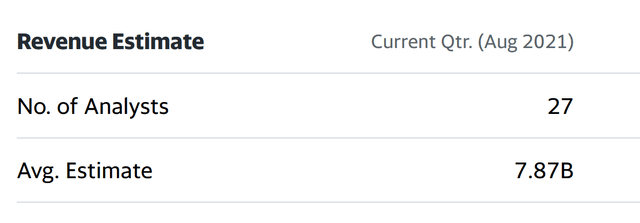
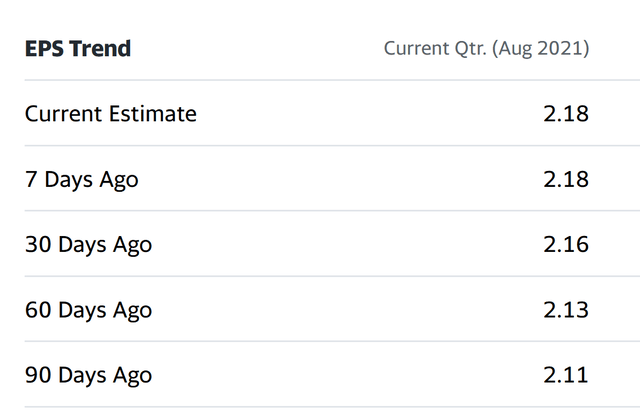
A snapshot of current street consensus shows the surprise, particularly on Revenue, a raise of $300m for the quarter.
So why the negative reaction in share price?
The negative reaction of the market may be attributed to two causes:
- a misunderstanding of the comment 'digital memory supply chains are going from a 'just in time' to 'just in case' configuration
- a raising of the capital expenditure forecast by Micron
From 'Just in time' to 'Just in case' Supply Chain Configuration
공급망 구성이 '적시 공급'에서 '만약의 사태에 대비하는'쪽으로 바뀌었다.
The pandemic has led to a massive disruption in global supply chains. There are numerous cases, particularly from the automotive industry where the unavailability of a couple of microcontrollers (that may cost as little as $4 each) has stalled the completion of an entire vehicle. Naturally, this is far from ideal. The ubiquity of the microcontroller shortage has pervaded many electronic consumer devices, and memory-intensive devices such as the Sony P5 PlayStation have also been affected.
The debate is best illustrated from CFO Zinsner's explanation during a JPM Presentation last month, explaining the disruption in supply chains induced by COVID
코로나 팬데믹은 글로벌 공급망에 집단적인 중단을 가져왔다.
여러가지 사례가 있는데, 특히 자동차 산업에서 2가지의 마이크로 컨트롤러 공급 중단이 있었다. 이들의 가격은 각각 4달러 정도인데 자동차 생산을 완전히 중단시켰다.
여러 분야에서의 마이크로컨트롤러의 공급 부족은 많은 전자기기에 영향을 미쳤고, 소니의 게임기와 같이 메모리를
많이 장착하는 기기도 영향을 받았다.
What I would like to point out here is that COVID definitely has shown the world particularly late last few quarters that supply availability is critically important in order for our customers to be able to meet their fast changing demand requirements as well. So what used to be a just in time kind of mindset for inventory management by our customers, now realizing the importance they may be making strategic changes and we know that in certain cases certain customers are making strategic changes as well with respect to inventory management. And really even looking at just in case, just in case, the certain disruptions happen in the supply chain, they need to be prepared with decent levels of inventory, to handle their own demand requirements.
This same concern has heightened analysts' concerns that a new layer of inventory may be injected into the demand of digital memory, and would lead to further leads/lags in demand. From yesterday's conference call,
Analyst Question
I guess, end-market demand question. There's clearly fears out there around PC speaking volatility around handsets and other - there's any inventory build on the cloud side.
Analyst Question
If you look at the three main end markets for DRAM, PC, cellphone server and your, I guess, your best guess of inventory in each, where would you say it's lowest? And then, when do you think that those end markets will achieve their, whatever the heck normal is, these days level of inventory?
CEO Sanjay Mehrotra
So, across the board, almost across all end markets, we are seeing strong demand. In fact, in the industry, there is unmet demand. And you know that there is semiconductor shortage across the technology ecosystem. And as that semiconductor shortage gets alleviated over time, that actually is going to create more demand for memory and storage because every end application today, whether it's analog IC-related or memory, CPU cores-related, all of them actually required memory and storage. So semiconductor shortage, which is actually impacting some of the demand, as that gets alleviated over the course of next seven quarters, that too will bring about increased demand.
My Elaboration
The possible negative in interpretation is that analysts jumped on the fact that MU's customers may now be adding inventory to create a buffer, and hence leads to more uncertainty in orders as there is a new customer inventory that adds to the supply as the industry is moving from 'just in time' to 'just in case' inventory.
But this is entirely rational for the industry, having been stalled, say in an assembly of a vehicle due to the shortage of a $4 microcontroller.
The concern expressed by analysts is totally misplaced. If industry has to reconfigure supply chains to avoid being hamstrung by the unavailability of a single microcontroller with NAND attached, this is not a negative for Micron! It simply illustrates a change in the supply chain due to the uncertainty created by optimal supply chains that are NO LONGER OPTIMAL DUE TO COVID DISRUPTIONS.
The Increase in Capital Expenditure
Another possible negative interpreted from the call was that Micron raised its capex estimate by about $300m.
또 하나의 부정적인 반응은 마이크론이 2021년회계년도 캐펙스를 3억달러 증액한다는 언급이었다
CFO Zinsner
As Sanjay mentioned, we now expect our FY21 capital spending to be somewhat higher than $9.5 billion.
Most of this CapEx increase that we are highlighting today will not increase our CY21 and CY22 bit supply.
We expect that while we invest in the EUV infrastructure and initial deployment, our capital intensity will increase to mid-30% of revenues. Once we get past the investment period of EUV adoption, we expect that these tools will boost our competitiveness and help drive productivity of our fabs.
마이크론 사장이 언급했듯이, 마이크론은 2021년 회계년도 캐펙스를 기존 95억달러보다 좀더 많이 투자할 것이다.
오늘 가장 중요하게 언급하는 투자 금액의 증액이 2021년과 2022년 메모리 공급을 증가시키지 않을 것이다.
왜냐하면 회사가 극자외선 장비에 투자하고 배치하는 동안, 투자 금액은 매출액의 30%대 중반에 달할 것이다.
일단 극자외선 장비 투자가 완료되면 우리는 이 장비가 우리의 경쟁력을 강화시키고, 생산성을 높일 것으로 생각한다.
As outlined in my linked article, the digital memory industry was historically plagued by boom-to-bust cycles as each supplier added new capacity during the good times; this in turn led to a supply glut shortly thereafter, resulting in a collapse of profitability of the memory suppliers. So, when management articulated the addition of new capital expenditure, analyst alarm bells began wailing.
However, the fear of a massive surge in capital expenditure, first by Micron than by the other memory suppliers, that will compromise the profitability of the upcoming cycle is highly exaggerated.
Micron simply highlighted the need of new EUV precision cutting equipment. The machine purchased from ASML (NASDAQ:ASML) for between $150m-$300m will be assembled and functional in F '24. There was also a fear of a shift in Micron's technology map.
Analyst Question
I had two questions, first on EUV and then on cost down. So Sanjay, I guess, the first question on EUV is sort of what's changed on EUV? I mean, it's not like there's been a sea change in progress made on EUV.
Sanjay Mehrotra
So, we had always said that we monitor EUV progress. We have actually engaged in EUV evaluation. We have had EUV tool in the past. So, we had always said that we will intercept EUV in our roadmap at the right time when we see the EUV platform as well as the ecosystem becomes more mature. That's when we plan to intercept EUV in our roadmap. And that's what our plan is that in the 2024 time frame, and again, aligned with our technology and leadership DRAM scaling roadmap that we'll be implementing this in 2024 timeframe.
My Elaboration
MU has avoided EUVs to date, rather focusing on other longer light rays lithographic cutting equipment. EUVs are used when you get into 5-7 nm wafers (in CPUs), something MU has eschewed to date as other cutting precision equipment has been satisfactory for their needs. But as Micron moves to higher node transitions in DRAM, Micron has made the now-economic decision to invest in this finer accuracy, probably for their next node DRAM transition in 2024.
As CEO repeated, this has always been the roadmap for the future, and is not negating their current technology roadmap. Remember in essence, bleeding-edge DRAM is probably on 14nm whilst CPUs are on 5-7nm, as DRAM needs a capacitor and transistor of a CPU, only a transistor.
Conclusion
I found myself dumbfounded after yesterday's earnings call and witnessing the negative market reaction. In my opinion, the earnings call was another landmark in the transformation of Micron in shedding its cyclical stripes to a secular growth story in the transformed landscape of digital memory. As outlined in my previous article, I believe Micron merits an EV/EBITDA multiple of at least 19 to reflect its transformation, closing the gap to Nvidia's (NVDA) 60X EV/EBITDA multiple as seen in the graph below. This leads to a price target of $204 as Micron re-rates to F '22 street consensus EPS of $10.75.
'반도체-삼성전자-하이닉스-마이크론' 카테고리의 다른 글
| 말레이시아 무기한 봉쇄 조치로 MLCC 공급 타격(2021.07.01) (0) | 2021.07.03 |
|---|---|
| 중국 반도체업계는 말레이지아 생산 중단에 대비했다(2021.07.01) (0) | 2021.07.02 |
| 마이크론 하락 이유(2021.07.02) (0) | 2021.07.02 |
| 마이크론 3분기(3월-6월3일) 실적 발표(2021.06.30) (0) | 2021.07.01 |
| 마이크론 목표가로 본 하이닉스 목표가(2021.06.30) (0) | 2021.06.30 |
